Project Details
The Background
Challenge: Retrofit's digital platform reflected technical implementation rather than user behavior. Inconsistent navigation, fragmented workflows, and the absence of UX standards created friction for users and inefficiencies for development. To better support lasting lifestyle change, the experience needed to be more intuitive, motivating, and grounded in user-centered design. Additionally, internal UX workflows and governance did not exist and it created inefficient development.
Business Need: The org needed to strengthen adoption and engagement while supporting coaches, clinicians, and future product growth-- and, as a startup, investors needed to see a promising return on their investment. Retrofit also needed stronger UX practices, shared design standards, and more effective collaboration between Product, Engineering, and Design to scale the platform efficiently.
User Need: Members were trying to build healthier habits, but interactions increased the effort required to stay engaged. The experience needed to simplify complex workflows, reduce cognitive load, and create moments of encouragement that supported long-term behavior change rather than simply tracking progress.
My Role
As the first Lead Product Designer, I owned the end-to-end user experience across Retrofit's web and native app platforms. I led UX strategy, research, information architecture, interaction design, visual design, prototyping, usability testing, developer collaboration, and implementation support. I introduced UX processes, reusable design patterns, documentation, and collaborative workflows that improved consistency across teams and helped establish a more mature, user-centered product practice.
My Hypothesis
I believed successful wellness products shouldn't just help users complete tasks, they should help people build healthier behaviors. By combining user research with principles from behavioral psychology, we could reduce friction, reinforce positive habits, and create an experience that felt more supportive, motivating, and sustainable over time.
How It Came to Life
Understanding the Behavioral Pschology of Wellness
The project began by understanding how participants, coaches, and internal teams actually used the platform. Through stakeholder interviews, usability evaluations, competitive analysis, analytics, and user research, I identified opportunities to simplify workflows and better align the product with users' goals rather than internal system structures.

Interating Through Research
Concepts were refined through iterative prototyping and usability testing, allowing the team to validate assumptions early and continuously improve navigation, content hierarchy, and interaction patterns before implementation.

Building a Scalable UX Foundation
The redesign extended beyond individual screens. I established the new design system, including all UI elements, iconography, photo themes, and other documentation.


Due to startup growing pains, there was a need for greater process that allowed UX to flourish with a very small and overseas Engineering team, no Product Manager, and no Tech Lead. I created UX standards that improved consistency and collaboration across products and between Product, Engineering, and Design. These foundations reduced UX debt and made feature development more efficient.
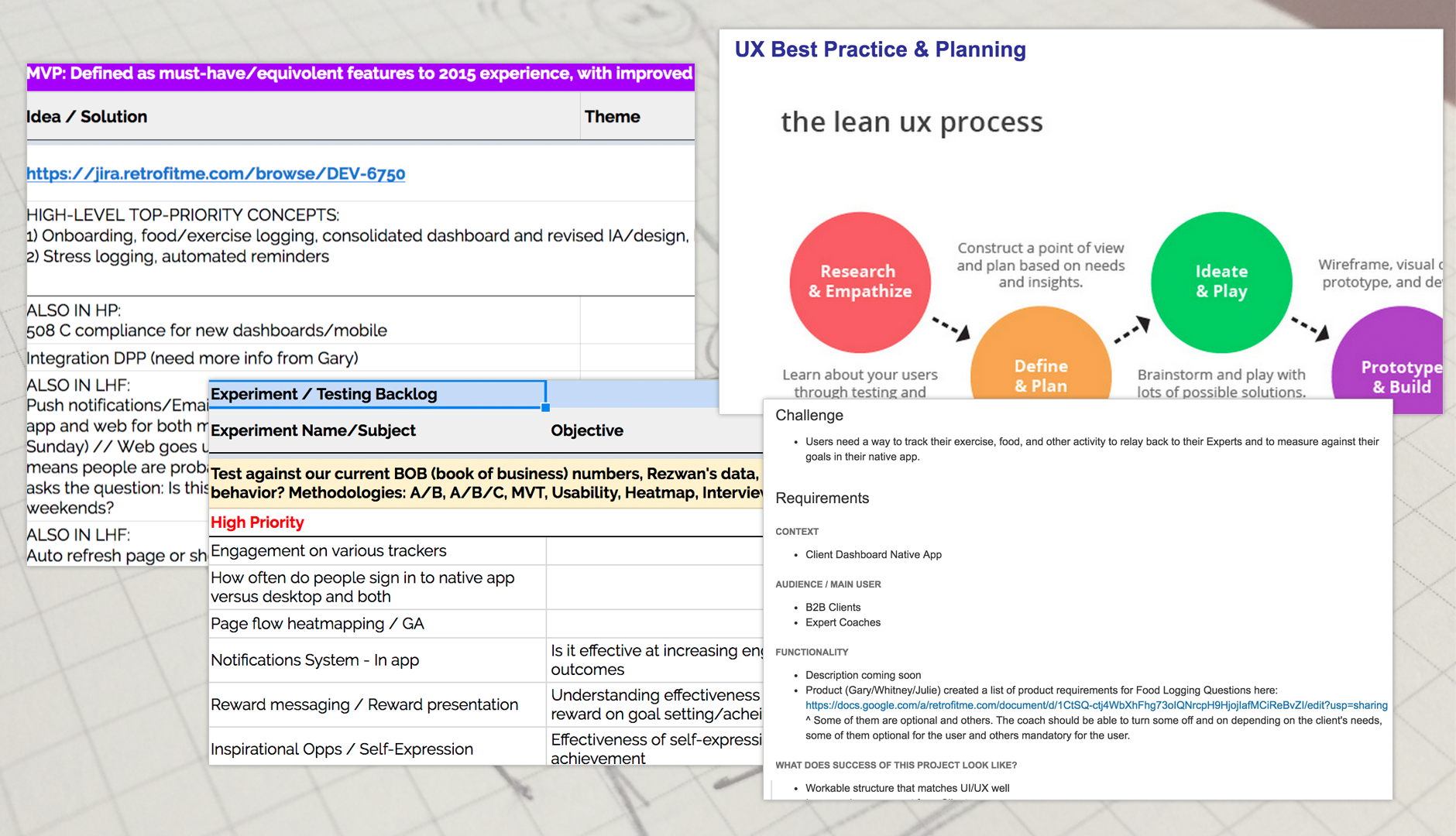
Ideation Happens
Something about wireframes


The Solution
Designing for Behavior Change & Simplifying the Experience
Research showed that lasting engagement depended on more than usability alone. I incorporated behavioral psychology principles—including positive reinforcement, anticipation, progressive achievement, and reduced cognitive effort—to encourage healthier habits without overwhelming users. Rather than treating psychology as a feature, these principles became part of the interaction model itself.
The redesigned platform replaced fragmented experiences with clearer navigation, more intuitive workflows, and a cohesive visual language that helped users focus on building healthy habits instead of learning how to use the product.
Features I created included dashboard, sign in, onboarding, messaging, journaling, calendars, tracking, help and learning, action center and task list, notifications and reminders, search, profile, goals and metrics tracking, tips and motivators, gamifying, community center, email, and SMS.


Accomplishments & Results
The redesign modernized Retrofit's flagship platform while helping establish a stronger UX foundation across the organization. Beyond improving the product experience, the initiative introduced scalable design systems, research-driven decision making, and collaborative workflows that enabled the team to design more consistently and deliver higher-quality experiences over time.
.png)


